
Alchatek

Contractor Training Portal

Access the full Alchatek contractor training library.

← All Modules Alchatek ☐ In Progress
Module 01 · Track 1 — Foundations · Start Here

Intro to
Polyurethane

"Magic glue," explained: the chemistry that makes foam expand, why product properties like viscosity, cell structure, and density decide which resin wins each job, and the field realities behind the spec sheet. Taught by Ammad Hashmi and Landon Feese.

9 LessonsThe ScienceFoundation ModuleFull Course

After this module, you'll be able to explain what happens chemically when foam kicks, read a TDS like an operator instead of a chemist, and reason from first principles about which product belongs on which job — the foundation every other module builds on.

Key Takeaways

One reaction runs it all: isocyanate (NCO) + water → polyurethane + CO₂ — and that CO₂ is the expansion.
Water-blown matters: refrigerant blowing agents evaporate out of drums over time, so expansion gets weaker drum by drum. Water-blown foam doesn't degrade that way.
Viscosity predicts travel: thin like water = far through soil; thick like honey = stays close. It's the first number to check on a TDS.
Closed-cell wins structural work: water-resistant, high compressive strength, and accelerated-aging data cited at 100 years in soil.
Hydrophilic vs hydrophobic is about the water schedule: constant water — hydrophilic; intermittent water — hydrophobic. And neither has anything to do with flexibility.
Free-rise specs are the floor: confined under a slab, foam compresses to several times its sheet density and strength.
Lesson 1

A Short History of "Magic Glue"

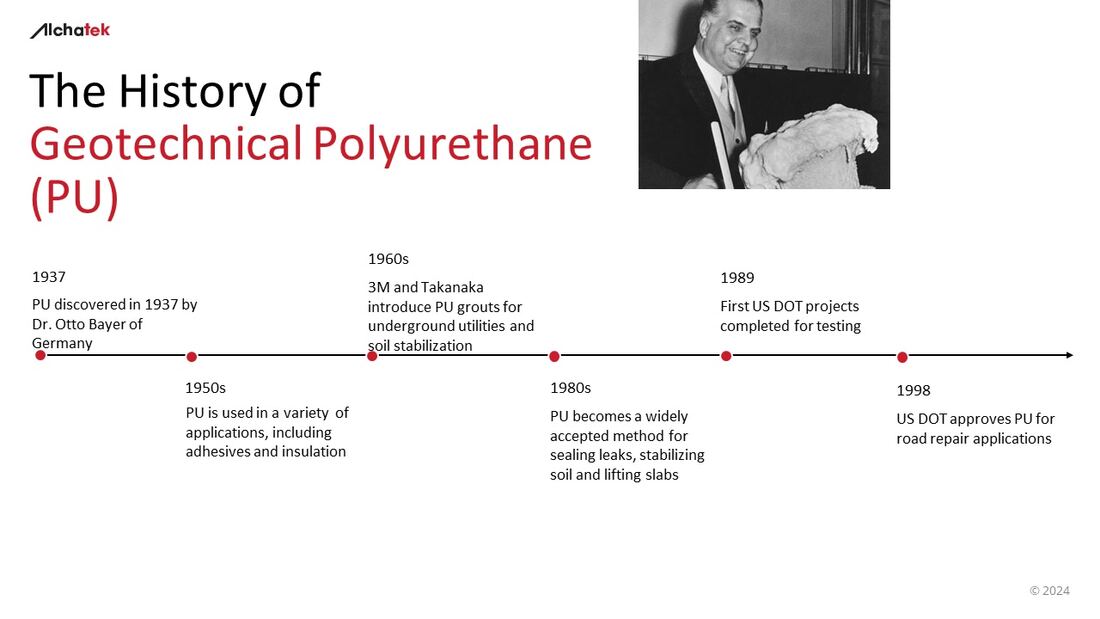
Polyurethane is younger than the interstate system: Dr. Otto Bayer discovered it in 1937 in Germany. The 1950s brought spray foam; the 1960s, adhesives, insulation, and the first PU grouts for underground utilities and soil stabilization (3M and Takenaka). By the 1980s it was a widely accepted method for sealing leaks, stabilizing soil, and lifting slabs; the first US DOT projects completed testing in 1989, and in 1998 the US DOT approved polyurethane for road repair applications.

That last date matters on sales calls: the materials you're injecting aren't experimental — they've been DOT-approved infrastructure repair for decades.
History of geotechnical polyurethane timeline
1937 → 1998. From Bayer's lab to US DOT approval for road repair.
Whiteboard: NCO + H2O reaction
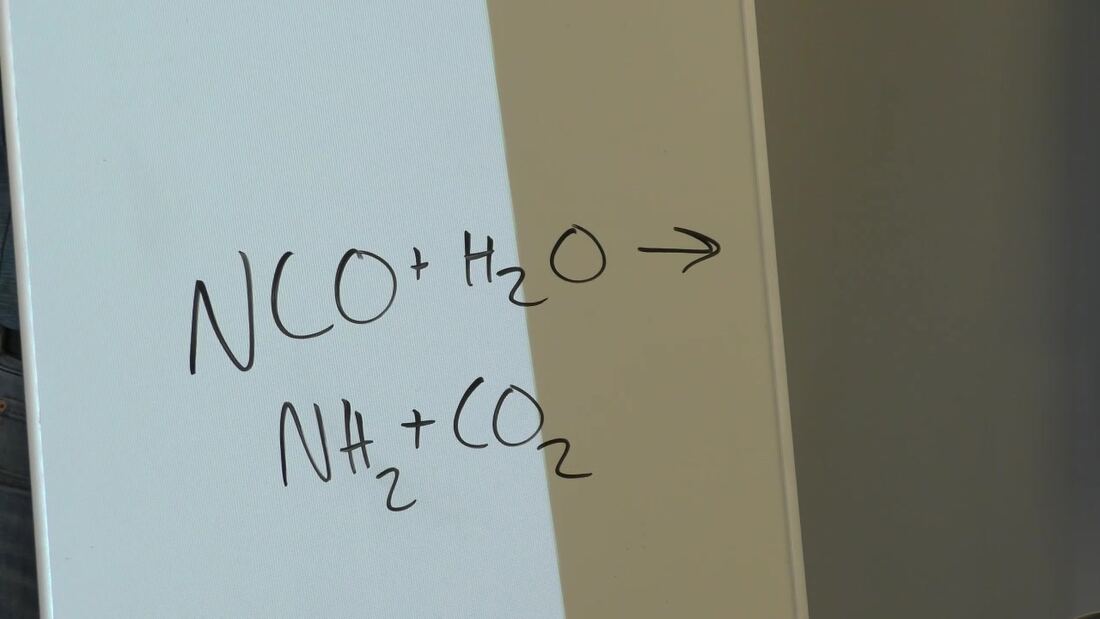
The whole business on one whiteboard. NCO + H₂O → polyurethane + CO₂.
Lesson 2

The Reaction

Every Alchatek product runs on the same chemistry: the isocyanate group (NCO) reacts with water (H₂O), producing the cured polymer — polyurethane — and releasing carbon dioxide. That CO₂, trying to escape a liquid that's becoming a solid, is what blows the bubbles. The foam you see rising in a cup is gas generation racing against polymerization.

"NCO is the isocyanate... when that reacts with H₂O, which is water, then you get your polyurethane — and during the reaction you also get a release of CO₂, carbon dioxide." — Ammad Hashmi, Alchatek

Understand that one line and half the field behavior makes sense: why moisture kicks single-component resins, why ISO and humidity don't mix in your equipment, and why temperature (which speeds the reaction) changes set times on every TDS table.

Lesson 3

Why Water-Blown Matters

Not all foam expands the same way. Some products on the market use refrigerant blowing agents — dissolved gases that boil off to create bubbles. The catch: those agents slowly escape the drum during storage. The foam from the top of a drum set expands beautifully; by the bottom, expansion sags — same product, inconsistent results.

"That blowing agent slowly comes out, and as you get lower in the drum set it's not going to expand as much... that's why all of our foam is water blown."— Ammad Hashmi, Alchatek

Every Alchatek foam is water-blown — the blowing agent is generated by the reaction itself, so the last gallon expands like the first. For you, that means yield math you can trust across a whole order.

Ventilation is mechanical, not optional. The reaction releases CO₂ and the materials carry vapors — in any confined space, "I opened the door" is not ventilation. Move air mechanically. (The Safety module goes deeper.)
Lesson 4

Two Isocyanates — TDI vs MDI

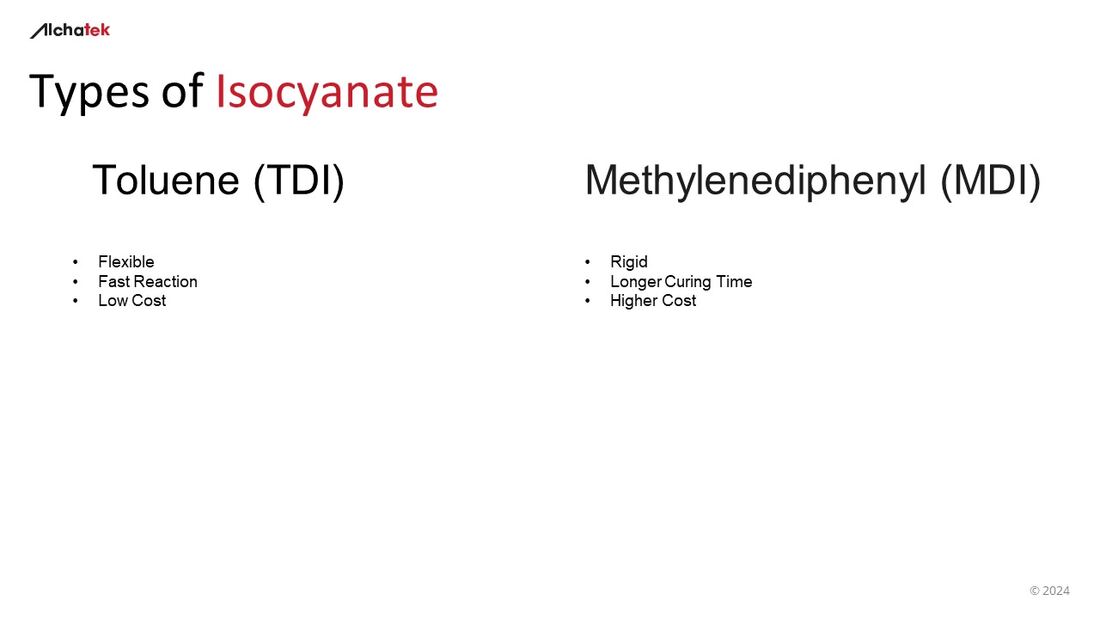
  • TDI (Toluene Diisocyanate): flexible foams, faster reaction, lower cost — but the higher health hazard: greater vapor pressure means more of it evaporates into the air you breathe, and it's a listed carcinogen.
  • MDI (Methylenediphenyl Diisocyanate): rigid foams, longer cure, higher cost — and meaningfully safer to handle.

In the Alchatek lineup, only GT-500 and GT-380 are TDI-based — and those are pre-reacted with polyol to minimize free TDI content. Everything else you'll pump is MDI-based. Practical translation: respect all A-side chemicals, and give the TDI-based leak-seal products extra respiratory caution.
TDI vs MDI comparison slide
The two families. TDI: flexible, fast, cheap, hazardous. MDI: rigid, slower, safer.
Lesson 5

Surfactants & Catalysts — The Supporting Cast

Surfactants (surface-active agents) give the bubbles strength while the foam transitions from liquid to solid — they're why a rising foam holds a cell structure instead of collapsing into a puddle. Flip the surfactant chemistry and you can deliberately break bubbles — that's how open-cell insulation foam is made.

Catalysts lower the activation energy of the reaction — they're the throttle on set time, which is why every single-component TDS publishes a catalyst-percentage table and why the equipment modules keep warning you about catalyst ceilings.
Runaway reactions are real. The reaction makes heat, and heat speeds the reaction. In manufacturing, an overheated batch can "run away" and solidify an entire tank. In the field, the same physics is why big confined void pours must be staged in lifts (see the Void Filling module).
Viscosity comparison table
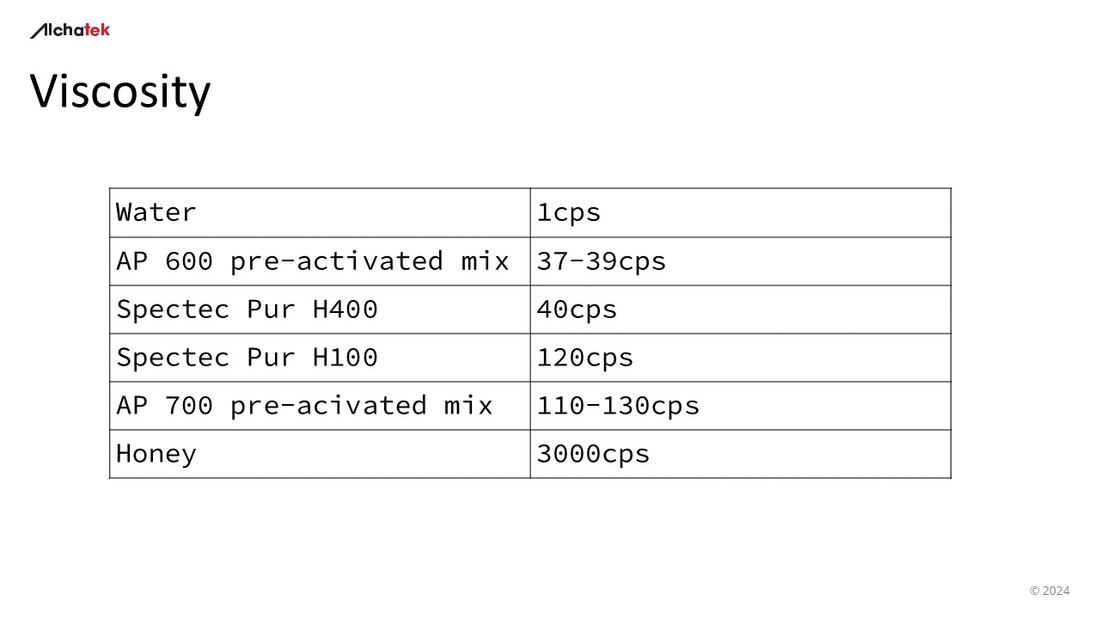
The viscosity ladder. Water at 1 cP to honey at 3,000 — your resins live between. (The trainer flagged the H400 line on this slide for verification — check the current TDS.)
Lesson 6

Viscosity — The Travel Number

Viscosity is resistance to flow: water is ~1 centipoise, honey ~3,000. On the table sit your tools — AP Soil 600's pre-activated mix at 37–39 cP (close to thin oil, built to soak through sand) up through AP Fill 700's mix at 110–130 cP (more body, more foam).

"The lower the viscosity, the faster it can travel through the ground and get into more spaces."— Ammad Hashmi, Alchatek

This is the first number to check when matching product to job: permeating tight sand wants thin; staying where you put it wants thick. The soil stabilization module's 600/700/720 selection logic is this lesson applied.

Lesson 7

Closed Cell vs Open Cell

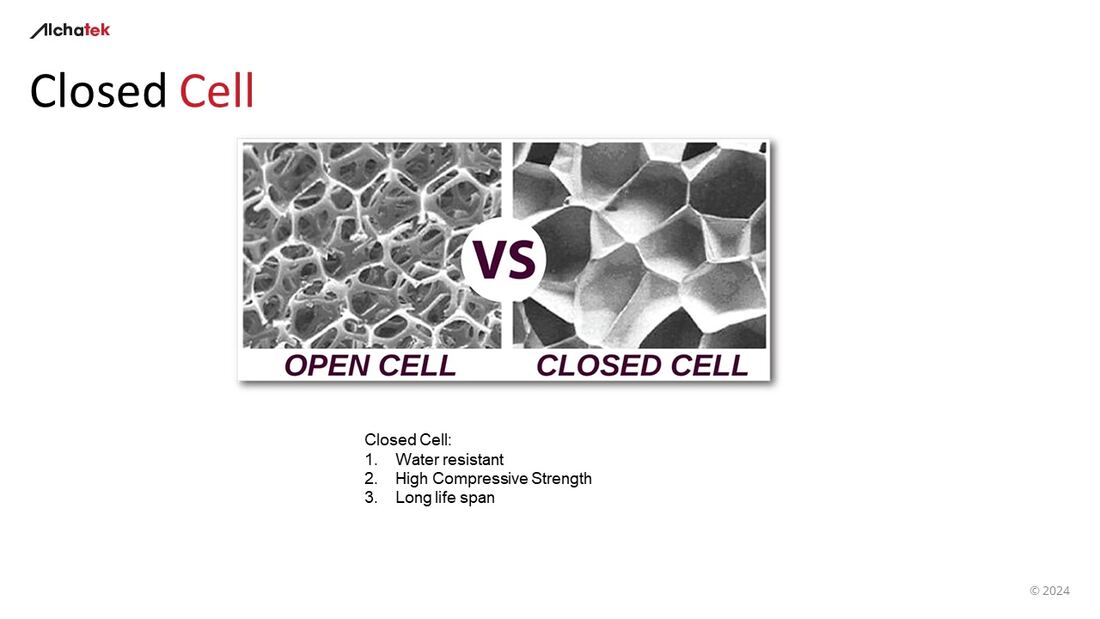
Look at cured foam under magnification and you'll see one of two architectures: open cell — interconnected pores that pass air and water (think insulation and filtration) — or closed cell — sealed bubbles that block water and carry load. Alchatek's structural foams are closed-cell: water resistant, high compressive strength, long lifespan.

How long? The accelerated-aging research cited in training (a Japanese study) puts it at 100 years in soil and 50 years in contact with concrete.

"Foam will last one hundred years in the soil, fifty years in contact with concrete — longer than you or me will be around."— Ammad Hashmi, Alchatek

Product mapping: rigid closed-cell for soil and slab work; the flexible family (F-400, GT-350, GT-380, GT-500) for waterproofing, crack injection, and joints that move. Curtain grouting can run rigid products — a curtain is a gasket, not a hinge.
Open cell vs closed cell comparison
The two architectures. Open cell passes water; closed cell blocks it and carries load.
Foam expansion demonstration cups
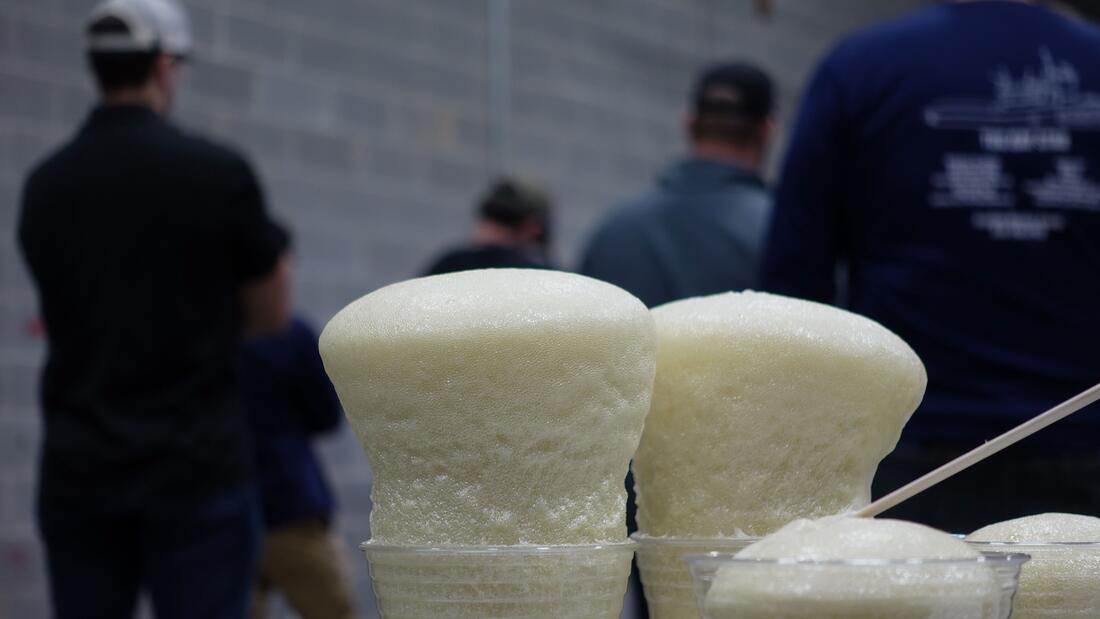
The classic demo. CO₂-driven expansion, risen and locked in the cup.
Lesson 8

Hydrophilic vs Hydrophobic

Two words that get misused on job sites. They describe molecular polarity — how the cured material relates to water. Hydrophilic materials attract water (a drop spreads and wets the surface); hydrophobic materials repel it (the drop beads and rolls). It's a spectrum, with hydro-insensitive in the middle — where most Alchatek structural foams live.

"Hydrophilic and hydrophobic have nothing to do with flexibility — it really just depends on the molecular polarity of each molecule."— Landon Feese, Alchatek

The selection rule: constant water presence → hydrophilic (the water keeps the material conditioned and strong). Intermittent water → hydrophobic (it won't shrink when the water table drops). Examples from the leak-seal family: GT-380 is strongly hydrophilic; F-400 is hydrophobic and flexible — proof the two properties are independent.

Lesson 9

Strength, Density & What the Numbers Mean

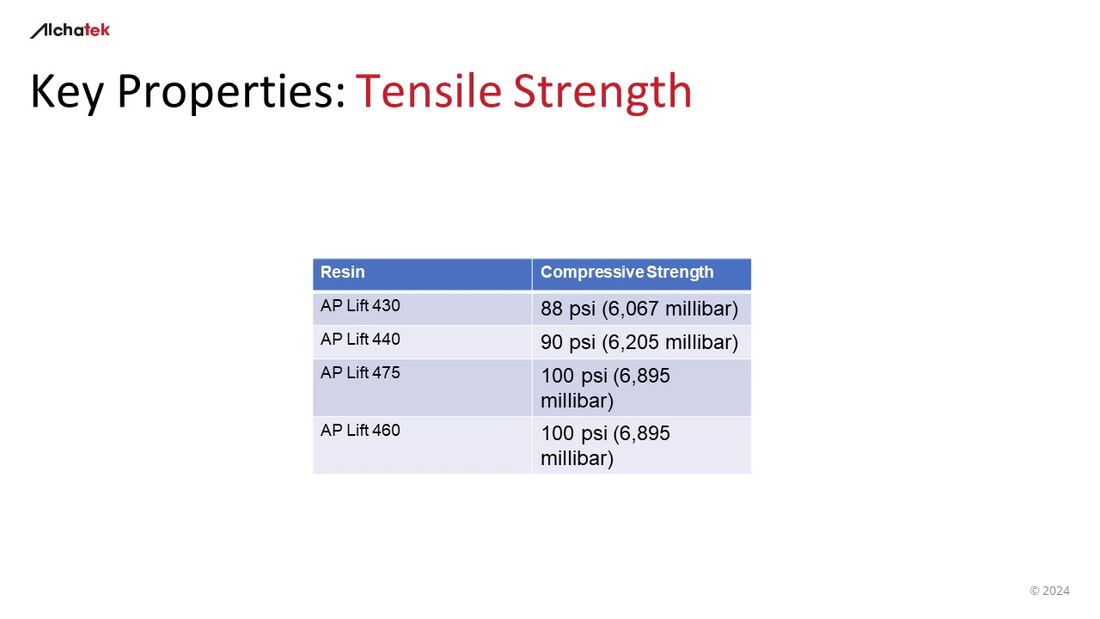
Compressive strength (measured per ASTM: compress a sample to 10% deflection, record the force) is the lifting number. Tensile strength — resistance to being pulled apart — matters when a slab loads unevenly and one zone of foam carries while another stretches. From the TDS: AP Lift tensile strengths run 88 psi (430), 90 psi (440), and 100 psi (475).

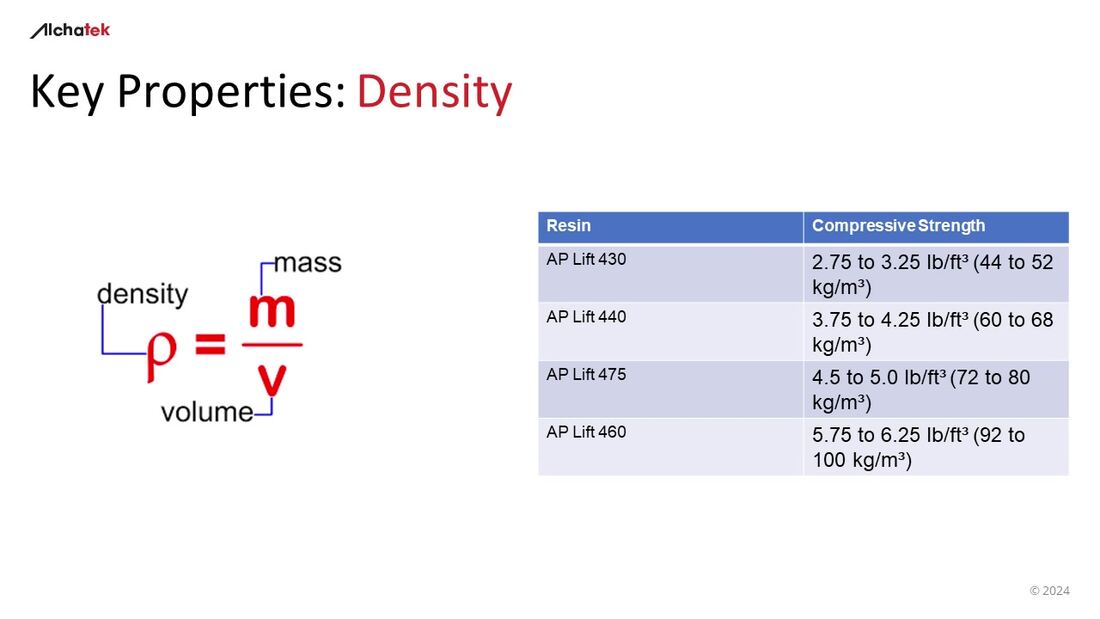
Density is the naming system: AP Lift 430 ≈ 3 lb/ft³, 440 ≈ 4 lb, 460 ≈ 6 lb — and 475 at 4.75 lb is, in the trainer's words, "the one that screwed it all up."
Tensile strength table
Tensile strengths by product. (Heads-up: this slide's table is labeled "Compressive Strength" — the values shown are the TENSILE figures from the TDS.)
Density table
Density bands. 430: 2.75–3.25 · 440: 3.75–4.25 · 475: 4.5–5.0 · 460: 5.75–6.25 lb/ft³.
Free-rise is the floor, not the field. Confined under a slab, foam can't expand fully — it cures denser and stronger. Training data: AP Lift 440 at 3x confinement produced roughly 12 lb/ft³ foam, and field core samples routinely test far above the free-rise sheet. (It's why the Jack Attack 80/20 rule works — see Slab Lifting.) Marina slabs carrying boat lifts and a hundred restaurant crawl spaces have been built on exactly this physics.

Vocabulary

NCO (Isocyanate)
The reactive group on the A-side — reacts with water to form polyurethane + CO₂.
Water-Blown
Expansion gas (CO₂) generated by the reaction itself — no evaporating blowing agent, no drum-to-drum drift.
TDI / MDI
The two isocyanate families: TDI flexible/fast/hazardous (GT-500, GT-380 only); MDI rigid/safer (everything else).
Surfactant
Holds bubble walls together while foam solidifies — cell structure's bodyguard.
Catalyst
Lowers activation energy — the set-time throttle, with hard ceilings per product.
Viscosity (cP)
Resistance to flow — water 1, honey 3,000. Lower = travels farther through soil.
Closed Cell
Sealed-bubble architecture: blocks water, carries load — the structural choice.
Hydrophilic / Hydrophobic
Water-attracting vs water-repelling (molecular polarity) — independent of flexibility.
Compressive vs Tensile
Push resistance vs pull resistance — lifting needs both when loads are uneven.
Free-Rise vs Confined
Spec-sheet density vs the denser, stronger foam confinement actually produces.
Runaway Reaction
Heat feeding reaction feeding heat — the reason big confined pours are staged.
Density Naming
AP Lift 430/440/460 ≈ 3/4/6 lb/ft³ — and 475 at 4.75 broke the pattern.

Knowledge Check

Score at least 4 of 5 to unlock module completion.

Q1. What makes polyurethane foam expand?
Compressed air injected with the resin
CO₂ released when the isocyanate (NCO) reacts with water
Heat from the pump's hydraulic system
Q2. Why does Alchatek use only water-blown foam?
It's cheaper to manufacture
Water-blown foam cures faster in winter
Refrigerant blowing agents evaporate from drums over time, making expansion inconsistent — water-blown doesn't degrade that way
Q3. Why is closed-cell foam the choice for soil stabilization and slab lifting?
Sealed cells resist water, carry high compressive loads, and last — cited aging data: 100 years in soil
It's softer and absorbs vibration better
Its open pores let groundwater drain through the slab
Q4. The repair zone sees water only when it rains hard. Which property profile fits?
Hydrophilic — it needs water to stay strong
Hydrophobic — it won't shrink when the water disappears between storms
Open-cell — to let the stormwater pass
Q5. A core sample from under a lifted slab tests far denser and stronger than the TDS free-rise numbers. Why?
The TDS numbers are wrong
The foam absorbed minerals from the soil
Confinement — foam that can't free-rise cures denser and stronger (440 at 3x confinement ≈ 12 lb/ft³)
Saved — your progress is updated on the Training Hub.
← Training Hub Safety & Equipment Training →