
Alchatek

Contractor Training Portal

Access the full Alchatek contractor training library.

← All Modules Alchatek ☐ In Progress
Module 06 · Track 2 — Applications

Introduction to
Slab Lifting

The complete slab lifting playbook: choosing the right AP Lift foam for the load, preventing the stains that cost you paychecks, the Jack Attack 80/20 method, drilling patterns, incremental lifting technique, and why structural polymers beat every alternative your customer is considering.

9 LessonsPlural-ComponentResidential to DOTFull Course

After this module, you'll be able to match foam density to the load, protect the customer's concrete from staining, combine mechanical jacks with foam the right way, lay out a drilling grid, walk a slab up in controlled increments, and win the sales conversation against mud jacking, overlay, and replacement.

Key Takeaways

Density follows load. AP Lift 430 for most residential/commercial, 440 for DOT and below-grade, 475 for industrial and heavy loads. 2-lb foam is not a lifting foam.
Staining is the #1 reason contractors don't get paid. Surface Guard 125 around every hole, before the first shot — it's prevention only.
The 80/20 rule: lift 80% with mechanical jacks FIRST, finish the last 20% with foam — so the foam cures under compression and gains density.
Never take one spot up more than ~1 inch. Walk the slab in quarter-inch passes or you'll crack it across the middle.
Diamond grid for lifting — it kills the point-load gaps. 3–4 ft centers with AP foams (vs 2–3 ft for competitor 2-lb material).
Water is the root cause. Gutters, downspouts, and grading sink most slabs — fix the water story or skip the warranty.
Lesson 1

The Product Ladder — Density Follows Load

One principle drives every product decision in slab lifting: as the load goes up, the foam density must go up. All four foams below are two-component, hydro-insensitive (they displace water and work in wet environments), closed-cell, bond to soil and concrete, and reach 90% of full strength in 15 minutes — the lifting foams are traffic-ready in 15 minutes.

ProductDensityExpansionFree-Rise CompressiveWhere It Belongs
AP Fill 4202 lb/ft³35x22 psiVoid filling, abandoned pipes, flotation — not a lifting foam
AP Lift 4303 lb/ft³25x50 psiThe all-around foam — most residential and commercial lifting
AP Lift 4404 lb/ft³18x80 psiDOT work and below-grade applications
AP Lift 4754.75 lb/ft³15x110 psiIndustrial, heavy-load — also available in a slow version

Densities, expansion, and strengths per current TDS (rev. 1/20/2026); confined strengths run far higher — see the TDS tables. All four are NSF/ANSI/CAN 61 certified for drinking-water contact.

AP Lift 460 rounds out the family as a specialized low-reaction foam for stabilizing soil without lifting — when you need to firm up the ground and leave the slab where it is.

Coming off 2-lb foam? If your crew has been running HMR-style 2-lb material, expect different coverage math from a higher-density foam — run the yield numbers before you quote, and lean on the strength story with your customers: a 3-lb foam at 25x expansion does structural work a 2-lb foam can't.
Lesson 2

Surface Guard 125 — Protect the Paycheck

"Staining is the number one reason contractors don't get paid." — Colt, Alchatek Technical Training

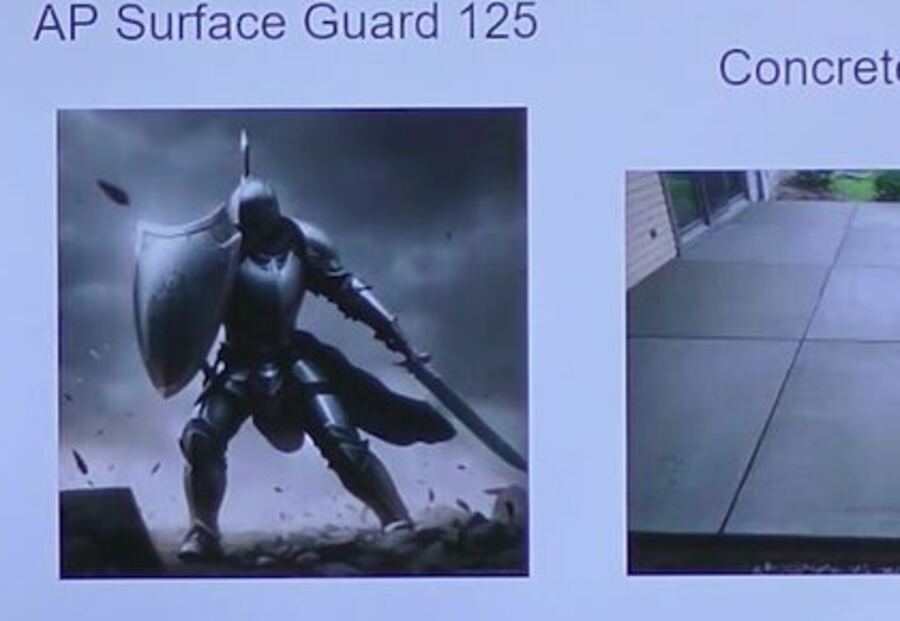
Polyurethane bonds to concrete — including the customer's driveway surface, where a drip or overspray becomes a permanent stain and a withheld payment. Alchatek Surface Guard 125 is the cheap insurance almost nobody uses: roughly one cup per gallon of water in a pump sprayer, applied around every injection hole before you pump. It lays down a film that keeps polymer from bonding to the surface — cured drips peel off instead of soaking in.
  • Preventative only. It does nothing for stains that already happened.
  • Spray a generous halo around every hole and anywhere hoses drag.
  • Pennies per job against the most common reason for nonpayment — make it standard kit.
Surface Guard 125 slide
Surface Guard 125. The shield for the customer's concrete — applied before the first gallon moves.
Lesson 3

Equipment Options

Three ways to put lifting foam under a slab:
Why every heated-hose machine has an airline: this equipment's primary market is spray-foam insulation. For slab lifting, the air assist isn't used — don't let the extra line confuse the setup.
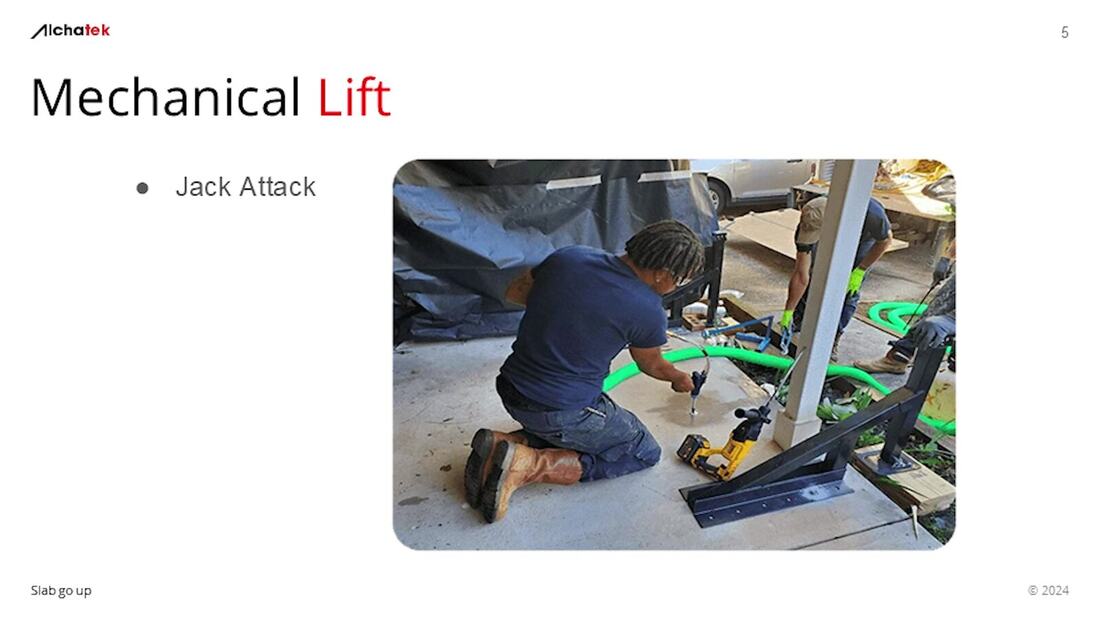
Jack Attack mechanical lift
The Jack Attack system. Screw-in anchors, mechanical jacks, controlled lift — foam comes last, not first.
Lesson 4

Mechanical Lift — The 80/20 Rule

The JackTech "Jack Attack" system is the discipline that separates clean lifts from callbacks: always set mechanical jacks first, lift roughly 80% of the way mechanically, and finish the last 20% with foam.

The reason is foam physics. Foam that free-rises into an open gap under a slab cures at low density — soft, weak, and headed for a callback. Foam injected under a jacked slab cures under compression, and compression is what gives these foams their structural numbers (the TDS confined-strength tables run 2–4x the free-rise values).

  • Jacks anchor with screw-in anchors, not wedge anchors — they hold and they remove clean.
  • The system turns a ~2-hour mechanical lift into about 30 minutes.
  • Jacks shine on "rolling" slabs that settled unevenly — control each corner independently, then lock it in with foam.
Lesson 5

Grid Patterns

Two ways to lay out injection holes — and the choice matters:

Standard Grid

• • • • •
• • • • •
• • • • •
• • • • •

Rows aligned. Preferred for deep injection work — predictable columns at depth.

Isometric (Diamond) Grid

• • • • •
 • • • •
• • • • •
 • • • •

Offset rows. Preferred for slab lifting — eliminates the point-load gaps between injection points.

Spacing with AP products runs 3–4 feet on center — wider than the 2–3 feet competitor 2-lb foams require, because the AP foams spread farther before they kick. Fewer holes, less patching, faster jobs.

Lesson 6

Incremental Lifting — Walk It Up

The core technique of the trade: never take any one spot up more than about an inch at a time. Lift a quarter inch here, move to the next hole, quarter inch there — and walk the lift back and forth across the slab until it's home. Stand on one corner and drive it up fast, and the slab cracks across the middle.

Honest expectations: roughly 80% of slab lifting jobs will crack a slab somewhere no matter how careful you are — concrete is brittle and it settled for a reason. Incremental lifting is how you keep cracks small, tight, and sellable instead of structural.
  • About half of slab work is void filling, half is lifting — diagnose which you're doing at each hole.
  • A dial indicator tells you whether you're filling a void (no movement) or lifting (movement) long before your eye can.
  • Doweling — rebar pinned between slab and foundation — changes the picture; find it before you plan the lift.
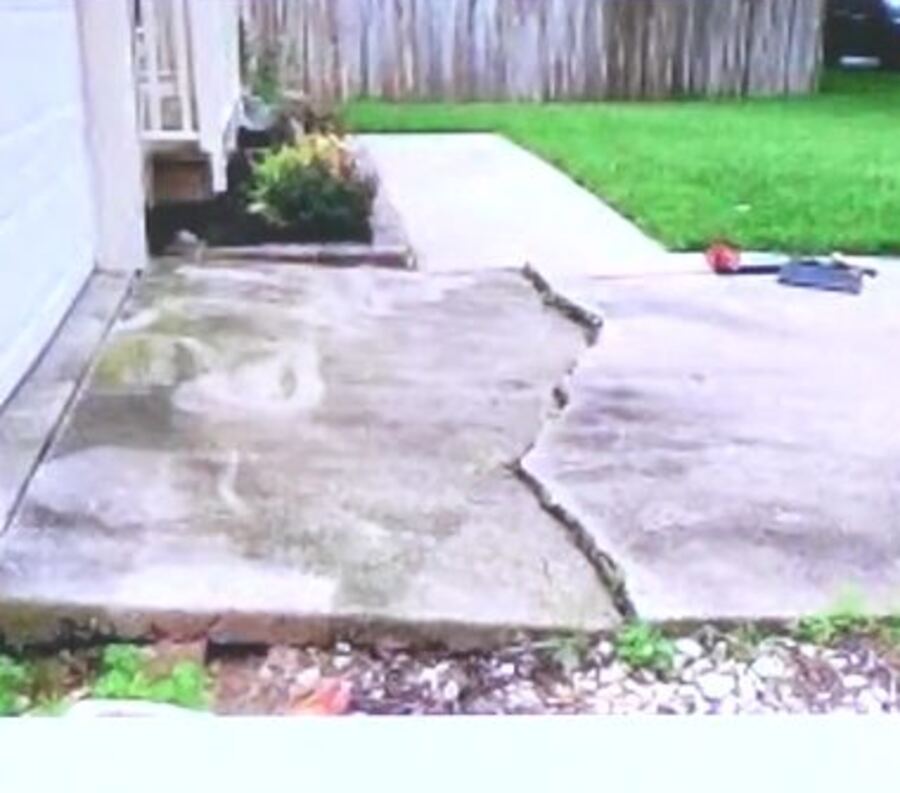
Settled driveway slab
The classic settle. Garage-edge slab dropped and cracked — a walk-it-up incremental lift, not a one-hole hero shot.
Lesson 7

Winning Against the Alternatives

Your customer is comparing you against three other ways to fix their slab. Know the table cold:

OverlayMud JackingRip & ReplaceStructural Polymers
DisruptionHighMediumVery HighVery Low
LongevityLowLowHighVery High
Crew availabilityLimitedLimitedScheduled outAlways
ControllabilityLowLowVery High
NoiseHighMediumVery HighVery Low
Eco-friendlyNoNoNoYes
Lesson 8

Case Studies — Residential to DOT

The Tennessee driveway: a slab settled 9 inches from years of gutter/downspout washout. Lifted, voids filled, adjacent slabs addressed — about 3 hours on site. The lesson isn't the lift; it's the diagnosis: the water problem got fixed first, which is what made a warranty possible.

Bridge approach slabs (Montana / South Dakota): deep injection combined with slab jacking on DOT work. Public infrastructure jobs typically start with DCP or SPT soil testing to set injection depths — the soil report drives the plan, not guesswork.
Winter is a season, not an off-season. The "nobody pumps in winter" line is a myth — with barrel heaters, thermal hose jackets, and a properly weatherized rig (a few thousand dollars, total), contractors pump year-round. The ones who winterize own Q1 while competitors hibernate.
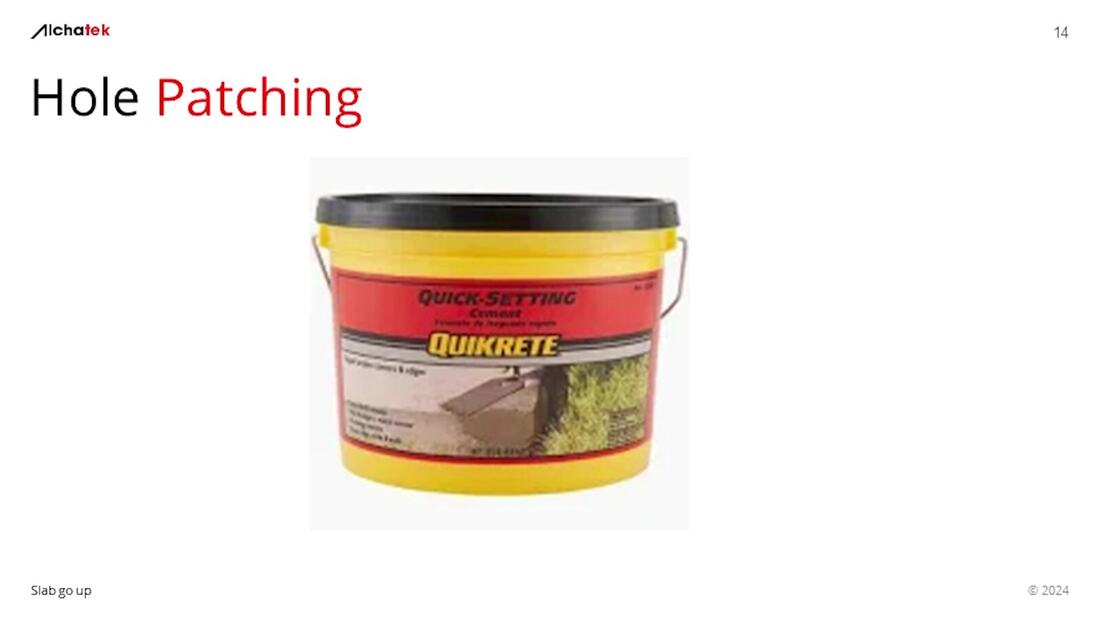
Quikrete quick-setting cement for hole patching
Patch with cement, not caulk. Quick-setting cement, sponge finish — holes disappear.
Lesson 9

Finishing — SlabSeal & Hole Patching

The last 30 minutes of the job is what the customer stares at for years. Two finishing disciplines:

Crack sealing with SlabSeal 142 (20-oz sausage tubes, caulking gun): proper application means running a chasing wheel down the crack first to grind a 45-degree channel — that gives the sealant the surface area to bond and the geometry to survive expansion and contraction. Topical caulking over an unprepared crack fails in about six months.

Hole patching: skip the caulk — it sags into the hole and telegraphs every port location. Use pre-mixed quick-setting cement (Quikrete quick-setting works), finish with a sponge, and the patch disappears into the slab.

3/8″injection ports
1/2″JackTech anchors
45°chased crack profile
~6 molife of an unprepared topical seal

Vocabulary

AP Lift 430 / 440 / 475
Two-component structural lifting foams — 3 / 4 / 4.75 lb/ft³. Density follows load.
AP Fill 420
2 lb/ft³, 35x expansion — void filling and flotation, not a lifting foam.
Surface Guard 125
Pre-applied stain-prevention film (≈1 cup/gal, pump sprayer) — prevention only.
Jack Attack (JackTech)
Mechanical jack system with screw-in anchors — the 80% of the 80/20 rule.
80/20 Rule
Lift 80% mechanically first, finish 20% with foam so it cures under compression.
Diamond Grid
Offset drilling pattern for lifting — eliminates point-load gaps between ports.
Incremental Lifting
Quarter-inch passes, never more than ~1 inch in one spot — walk the slab up.
Doweling
Rebar tying a slab to adjacent slabs or foundation — find it before you lift.
Hydro-Insensitive
The AP foams displace water and cure properly in wet environments (per TDS).
SlabSeal 142
Crack sealant in 20-oz sausage tubes — requires a 45° chased channel to last.
Chasing Wheel
Grinder wheel that cuts the 45° profile a crack sealant needs to bond.
DCP / SPT
Soil penetration tests that set injection depth on DOT and commercial work.

Knowledge Check

Score at least 4 of 5 to unlock module completion.

Q1. What is the 80/20 rule of mechanical lifting?
80% of jobs need jacks, 20% don't
Lift 80% of the way with jacks first, then finish the last 20% with foam — so the foam cures under compression
Use 80% foam and 20% mud slurry
Q2. A warehouse floor carries forklift traffic all day. Which foam belongs under it?
AP Fill 420 — maximum expansion fills fastest
AP Lift 430 — the all-around foam works everywhere
AP Lift 475 — 4.75 lb/ft³ density for industrial and heavy loads
Q3. When and why do you apply Surface Guard 125?
Before pumping, around every hole — it's a preventative film, and staining is the #1 reason contractors don't get paid
After the job, to remove any stains that occurred
Only on DOT work where specs require it
Q4. What's the maximum lift you take at any one spot before moving on?
Whatever the slab will give you
Three inches, then check the dial indicator
About one inch — work in quarter-inch passes and walk the lift across the slab
Q5. Why is the diamond (isometric) grid preferred for slab lifting?
It uses fewer holes than any other pattern
The offset rows eliminate point-load gaps between injection points
It's required by DOT specifications
Saved — your progress is updated on the Training Hub.
← Introduction to Deep Lock Void Filling →