
Alchatek

Contractor Training Portal

Access the full Alchatek contractor training library.

← All Modules Alchatek ☐ In Progress
Module 07 · Track 2 — Applications

Void Filling

A third of all two-component poly work is void fill — and it's won or lost on three skills: picking the right expansion-vs-strength tradeoff, doing the yield math before you quote, and respecting the heat. Taught by Andy Powell with Steve Taylor, Alchatek Technical Bootcamp.

6 LessonsTwo- & Single-ComponentEstimating MathFull Course

After this module, you'll be able to choose the right foam on the expansion-vs-strength curve, calculate gallons and pounds for any void from its volume, fill large voids without creating a fire risk, and work the full application landscape — from slip-lined pipes to bridge abutments to aggregate injection.

Key Takeaways

The inverse law: more expansion = less density = less compressive strength. Volume jobs go high-expansion; structural jobs go high-density.
The yield math: 1 gallon = 0.1333 ft³ of liquid × expansion rate = cubic feet per gallon. Divide the void volume by that and you've got your order.
Heat is the hazard. Foam poured fast into a big enclosed space can build internal temperature to ignition — stage your lifts and let them cool (it's on every TDS).
~1/3 of all two-component projects are void fill. It's not a side application — it's a core business line.
Poly Protection sells: filling voids before the concrete settles or cracks — preventative injection is an open growth market.
Single-component under slabs only works mixed with sand or rock — and aggregate jobs are estimated on annular-space percentage, not gross volume.
Lesson 1

The Void Fill Market

Voids hide everywhere concrete meets soil: under pavements and garage slabs, behind bridge abutments, around buried structures, in the annular space of slip-lined pipes, under spillways. Roughly a third of all two-component polyurethane projects are void fill — making this one of the most bankable skills in the geopolymer trade.

The growth play — Poly Protection. Filling a void under concrete before it settles or cracks ("preventative poly injection") turns an emergency repair trade into a maintenance contract trade. Facilities with known washout zones, utility trenches, or aging pipe runs are subscription customers waiting to be asked.
Lesson 2

Safety First — The Fire Lesson

The session opens with a lawsuit, on purpose. A foam manufacturer was sued after a factory fire: foam had been used to fill a large enclosed space in a short period, and the suit alleged the company knew of prior fire incidents and failed to provide written guidelines, warnings, and installer training.

The chemistry behind the case: polyurethane cures exothermically. In an open lift the heat dissipates; in a massive confined pour, each lift traps the heat of the one before it, and internal temperature can climb to the point of degradation — or ignition. This isn't folklore; it's printed on the Alchatek TDS: "Excessive foam build-up in confined spaces can result in high internal temperatures and expansion pressures. In large void fills, stage injections and allow cooling time between lifts."

Lesson 3

Product Selection — The Inverse Law

One curve governs the whole product family: as expansion goes up, density and compressive strength go down. Pick where the job sits on that curve — maximum volume per gallon, or maximum structure per cubic foot:

ProductDensityExpansionFree-Rise CompressivePick It For
AP Fill 4202 lb/ft³35x22 psi (≈3,170 psf)Maximum volume — big non-structural voids, abandoned pipes
AP Lift 4303 lb/ft³25x50 psi (7,200 psf)The balance point — most structural void fill
AP Lift 4404 lb/ft³18x80 psi (11,520 psf)Heavier loading, DOT and below-grade
AP Lift 4754.75 lb/ft³15x110 psi (≈15,840 psf)Industrial loads — strength over yield

Values per current TDS (rev. 1/20/2026); confined strengths run 2–4x higher — see the TDS tables. The training chart's figures vary slightly from TDS — the TDS is the authority.

The estimating consequence is direct: the cheap-per-cubic-foot product is the high-expansion one — but only when the void doesn't need to carry load. Quote 420 under a working slab and the callback eats the savings.

Lesson 4

The Math Behind the App

Every void fill estimate is three steps:

  1. Yield per gallon: one gallon of liquid is 0.1333 ft³ — multiply by the product's expansion rate.
  2. Gallons needed: divide the void volume by the yield per gallon.
  3. Pounds to order: combined A+B weighs about 9.5 lbs per gallon.
Worked example (as taught):100 ft³ void, AP Lift 430
Yield: 0.1333 ft³ × 24x≈ 3.2 ft³/gal
Gallons: 100 ÷ 3.2= 31.25 gal
Pounds: 31.25 × 9.5≈ 297 lbs

The class example uses 24x for AP Lift 430; the current TDS rates it 25x unconfined — run your own numbers off the TDS for the product and remember confined foam yields less than free-rise.
Estimate conservative. Real voids confine the foam (less than free-rise yield), hold water, and hide pockets. The math gives you the floor of the order, not the ceiling.
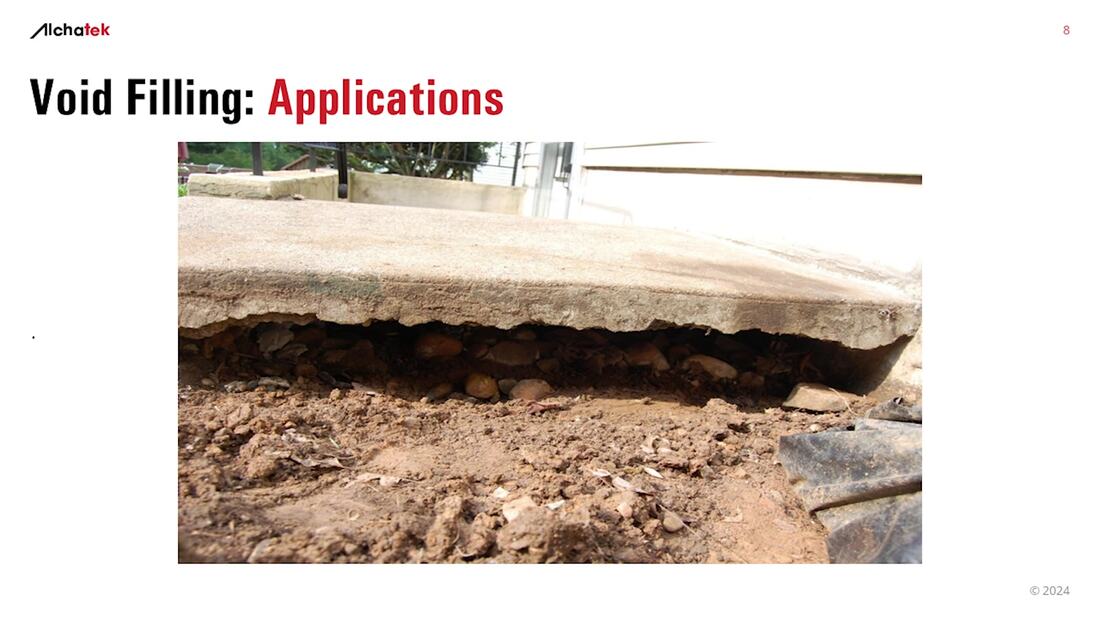
Large void under a concrete slab
What you're filling. A real void under pavement — loose aggregate, washed-out soil, and a slab carrying load it was never meant to bridge.
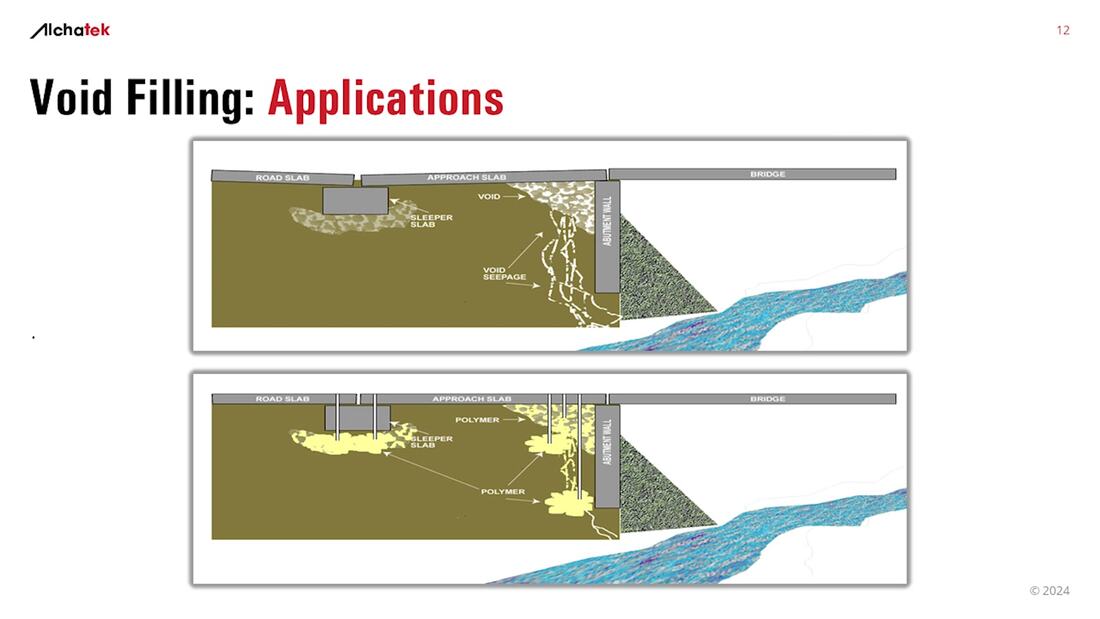
Bridge abutment void diagram
The bridge abutment picture. Road slab, approach slab, sleeper slab, abutment wall — and the void seepage path the polymer has to close.
Lesson 5

Two-Component Applications

  • Annular space between structures — the classic slip-lined pipe: foam filling the gap between host pipe and new liner.
  • Voids under any pavement — roads, aprons, garage slabs, warehouse floors.
  • Around buried structures — pipe-to-manhole penetrations, where washout starts.
  • Behind bridge abutments — find the sleeper-slab void AND the abutment washout feeding it (the same step-back rule as Deep Lock).
  • Under spillways — moving water means voids; voids mean undermined concrete.
  • Stadium and commercial structures — large-scale fills under seating and plaza slabs.

Two-component wins these on speed and force: it displaces standing water, kicks in seconds, and reaches 90% strength in 15 minutes (per TDS) — traffic-ready before the crew packs up.

Lesson 6

Single-Component Applications

  • Abandoned pipe fill · pipe-to-manhole joints · between slip-lined pipes
  • Behind walls — concrete or sheet pile
  • Under spillways, and into aggregate — sand or rock
  • Under slabs ONLY when mixed with sand or rock — single-component needs a matrix to bind; on its own it won't carry slab loading.
The annular-space rule for aggregate: when filling voids in gravel or sand, the foam only occupies the space between the particles. Calculate the total volume including the aggregate, then multiply by the aggregate's annular (void) percentage to get the real void volume — estimate off gross volume and you'll order three times the material you need.

Product selection follows the soil stabilization module's matrix: AP Fill 700 where permeation plus expansion helps; AP Fill 720 where sealing and bulk matter most.
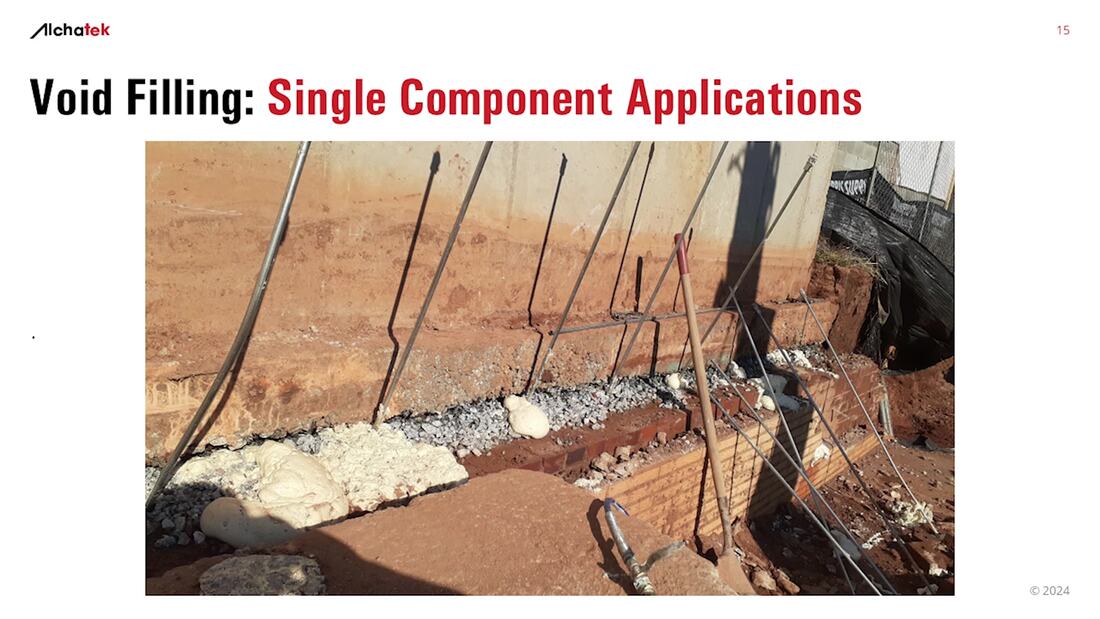
Single component injection into aggregate at a wall
Into aggregate. Single-component binding the stone matrix behind a wall under construction.
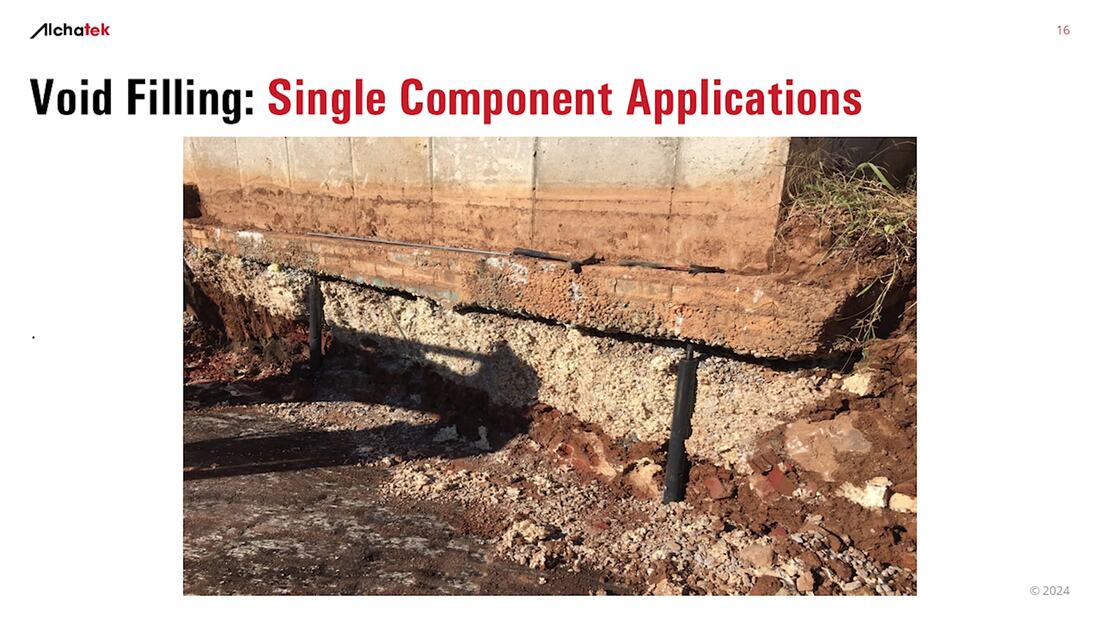
Cured single-component foam at foundation base
Behind walls. Cured single-component sealing and filling along a foundation base.

Vocabulary

Void Filling
Injecting polyurethane into empty space beneath or around structures — ~1/3 of all two-component work.
The Inverse Law
Higher expansion = lower density = lower compressive strength. The selection curve.
Yield per Gallon
0.1333 ft³ × expansion rate — the number every estimate starts with.
9.5 lbs/gal
Approximate combined A+B weight per gallon — converts gallons to the pounds you order.
Annular Space
The gap between two concentric structures — or the void fraction inside an aggregate.
Poly Protection
Preventative injection — filling voids before settlement or cracking happens.
Slip-Lined Pipe
A new pipe inserted in an old one; the annular gap between them is a void-fill job.
Sleeper Slab
The buried slab under a bridge approach — a classic hidden-void location.
Staged Lifts
Filling large voids in passes with cooling time between — the TDS-mandated fire prevention.
Exotherm
The heat of the curing reaction — harmless in lifts, dangerous in one giant confined pour.
AP Fill 420
The volume product: 2 lb/ft³, 35x — big non-structural fills.
AP Lift 475
The strength product: 4.75 lb/ft³, 110 psi free-rise — industrial loads.

Knowledge Check

Score at least 4 of 5 to unlock module completion.

Q1. What's the relationship between expansion rate and compressive strength across the foam family?
They rise together — more expansion means more strength
Inverse — higher expansion means lower density and lower compressive strength
There's no relationship; they're independent properties
Q2. Using the class math (3.2 ft³/gal yield, 9.5 lbs/gal), what does a 100 ft³ void take?
About 10 gallons / 95 lbs
About 100 gallons / 950 lbs
About 31 gallons / roughly 297 lbs
Q3. Why do large enclosed void fills have to be staged in lifts with cooling time?
The curing reaction is exothermic — one giant confined pour can build internal heat to degradation or even fire
The foam shrinks if poured all at once
It's only a billing convention for big jobs
Q4. When can single-component resin be used for void fill under slabs?
Any time — it's interchangeable with two-component
Never — single-component is only for walls
Only when mixed with sand or rock — it needs a matrix to bind to carry slab loading
Q5. Estimating a void fill into gravel — what adjusts the volume calculation?
Nothing — use the gross volume of the gravel zone
Multiply total volume by the aggregate's annular-space percentage — the foam only fills the space between particles
Double the gross volume to account for expansion losses
Saved — your progress is updated on the Training Hub.
← Introduction to Slab Lifting Titan Impact 440 Pump →