
Alchatek

Contractor Training Portal

Access the full Alchatek contractor training library.

← All Modules Alchatek ☐ In Progress
Module 02 · Track 1 — Foundations

Safety & Equipment
Training

The hazards on a polyurethane job site are real but predictable: ISO sensitization, confined spaces, chemical burns, fire, and the gun in your hand. This course covers every one of them — plus the equipment landscape your crew will live in — so nothing on the rig surprises you.

8 LessonsSafety + EquipmentFoundation ModuleFull Course

After this module, you'll be able to identify the equipment on any Alchatek-style rig, protect yourself and your crew from ISO exposure and sensitization, work confined spaces correctly, prevent the fires this trade can start, and show up to any job site wearing exactly what it requires.

Key Takeaways

ISO sensitization is cumulative. Every unprotected exposure builds sensitivity — not tolerance. Protect yourself from day one, not after the first reaction.
"I opened the door" is not ventilation. Confined and concealed spaces require mechanical air movement and gas monitoring, every time.
The most common accident is foam in the eyes. Wraparound eye protection is the cheapest insurance in the trade.
Treat injection guns like firearms: safety on until the moment of use, and never pointed at a person.
Never refuel a running or hot engine. Gasoline vapor and a hot muffler is how rigs burn.
Confirm PPE requirements before you arrive — Class 2 vests, ankle reflectors, and climbing-style hard hats are increasingly required on commercial and DOT sites.
Lesson 1

Safety Is the #1 Core Value

This module opens the same way Alchatek's EH&S team opens every bootcamp: onsite safety is the first core value of this work — ahead of production, ahead of schedule. Three disciplines underpin everything that follows:

  • Emergency action — know what you'll do before you need to do it: exits, extinguishers, eyewash, who calls, who drives.
  • Hazardous material handling — every drum and pail on your rig has an SDS; know where they are and what they say.
  • Restricted area awareness — the boundaries on a site exist for reasons you may not see. Observe them.

The economics back the ethics: a single chemical-burn injury cited in this training generated a $60,000 workers' comp claim. Nothing you save by skipping PPE survives one incident.
Safety is Alchatek's number one core value
From the EH&S deck. Emergency action, hazmat handling, restricted access — the three disciplines.
Lesson 2

The Equipment Landscape

Before the hazards, the hardware — a quick map of what you'll operate (each piece gets its own deep-dive module in the Equipment track):

Why this matters in a safety course: every incident category in the rest of this module lives on one of these machines. Knowing the hardware is the first layer of protection.
Lesson 3

Moisture, ISO & the Sacrificial Whip

Module 01 taught you the chemistry: ISO reacts with water. That's the reaction that lifts slabs — and the one that destroys equipment when moisture gets where it shouldn't:

Lesson 4

Chemical Hazards — ISO, Catalysts & Cleaners

The A-side (ISO) is the chemical to respect most. Skin contact causes irritation — but the real danger is sensitization: exposure is cumulative, and your body builds sensitivity, not tolerance. Veterans of the spray-foam industry who worked unprotected for years now react to trace exposure and can't work near the material at all. That's a career-ending condition, and it's entirely preventable with the PPE in Lesson 7.

Lesson 5

Confined & Concealed Spaces

Crawl spaces, vaults, manholes, pits — this trade works where air doesn't move. The rules are absolute:
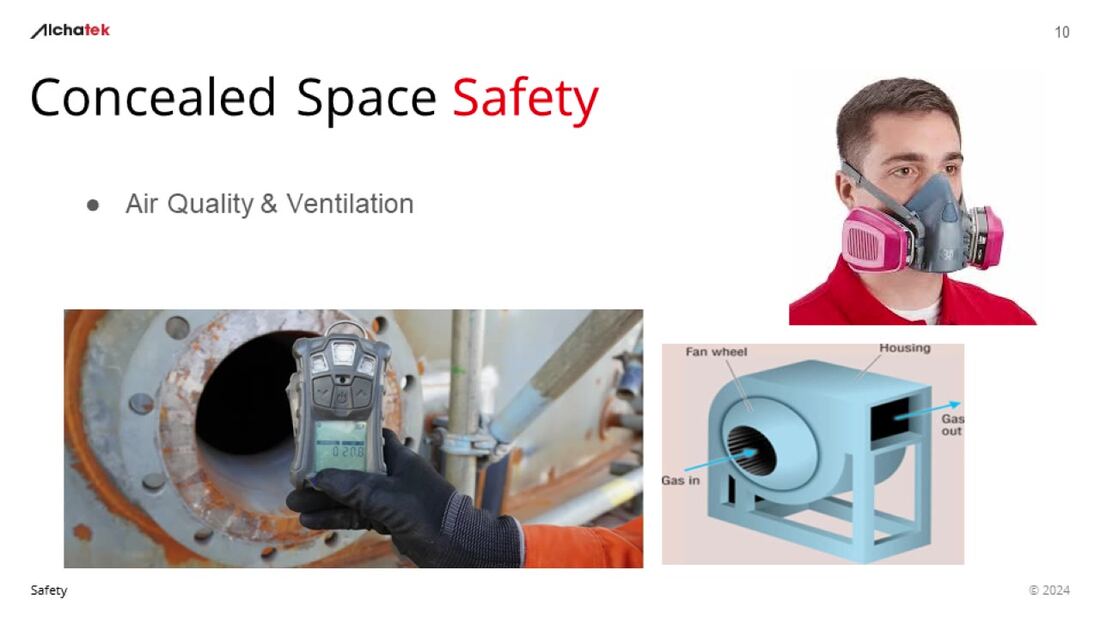
  1. Mechanical ventilation, always. Opening a door or hatch is not ventilation — move air with a fan, in and out, the entire time anyone is inside.
  2. Gas monitor on the person in the space. CO₂ from the reaction and vapors from the materials displace oxygen exactly where you're lying.
  3. Never alone. An attendant stays outside the space, in contact, the whole time.
  4. FR clothing where the site requires it — and in electrical vaults, work only after the utility confirms the equipment is de-energized. High-voltage vaults are no place for assumptions.
Concealed space safety slide
Air quality & ventilation. Monitor the atmosphere, move the air mechanically — every time, no exceptions.
Lesson 6

Fire & Engine Safety

And from the Void Filling module, the materials-side fire rule: large confined foam pours are staged in lifts with cooling time — the curing reaction makes real heat.
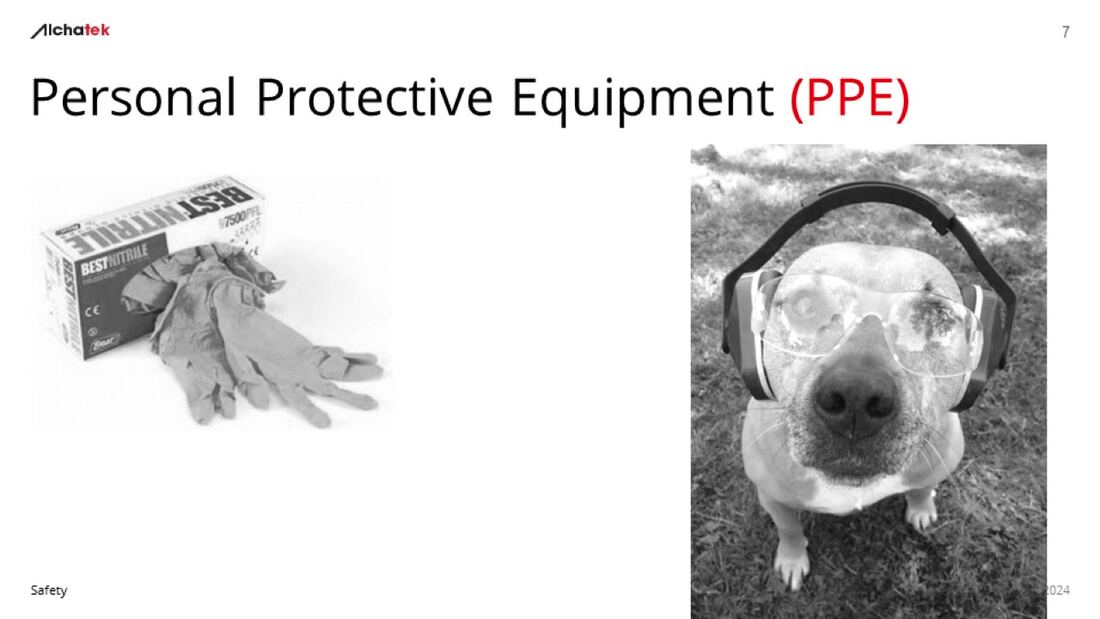
PPE slide
The PPE baseline. Eyes, hands, skin — covered before the pump turns on.
Lesson 7

PPE & Job Site Requirements

  • Eyes: safety glasses minimum, wraparound preferred — goggles where overhead or windy injection puts spray in the air.
  • Hands: nitrile gloves, changed when contaminated (and remember the A-side glove rule from the equipment modules: touch the A, those gloves are trash).
  • Skin: long sleeves and long pants, period — plus that change of clothes in the truck.
  • Commercial/DOT sites: Class 2 safety vest, DOT ankle reflectors where required, and climbing-style hard hats — the chin-strap style newer specs increasingly demand.
Call before you haul. PPE requirements vary site to site — confirm them before you arrive, not at the gate. Showing up wrong wastes a mobilization; showing up right is free.
Lesson 8

Gun Safety & The Common Accidents

The injection gun in your hand moves chemical at high pressure. The discipline is the same one firearms teach: treat every gun as live, keep the safety on until the moment of use, and never — ever — point it at a person. Accidental discharge is one of the trade's three recurring accidents, and it's pure handling discipline.

The big three, by frequency:

  1. Foam in the eyes — the most common incident in the trade. Wraparound eye protection (Lesson 7) exists for exactly this.
  2. Skin irritation from the A-side — gloves, sleeves, and immediate washing on contact (sensitization is cumulative — Lesson 4).
  3. Accidental discharge — safety on, finger off, muzzle discipline.

Every one of the three is prevented by gear you already own and habits that cost nothing. That's the whole course in one sentence.
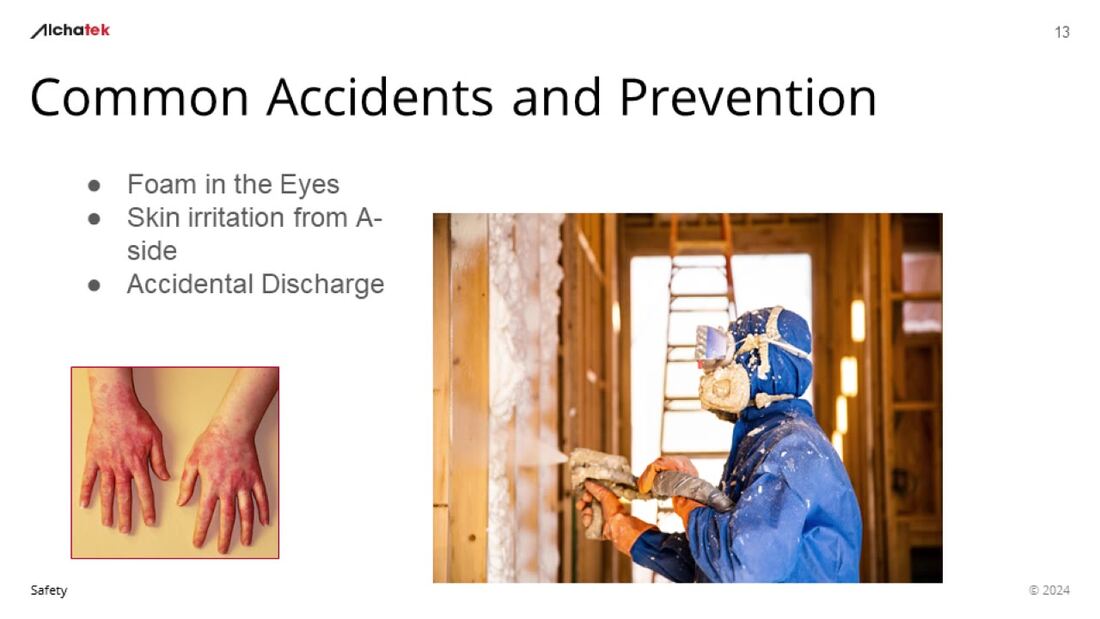
Common accidents and prevention slide
The big three. Eyes, skin, discharge — all preventable with baseline PPE and gun discipline.

Vocabulary

ISO Sensitization
Cumulative immune response to isocyanate exposure — builds sensitivity, not tolerance; career-ending at the extreme.
SDS
Safety Data Sheet — one exists for every chemical on your rig; know where they live.
Mechanical Ventilation
Powered air movement in a confined space — the only kind that counts.
Gas Monitor
Worn by the person in the space — detects oxygen displacement and vapor buildup.
FR Clothing
Flame-resistant workwear required on certain industrial and utility sites.
Flashpoint
The temperature at which a fluid produces ignitable vapor — vapor is the fire.
Desiccant Dryer
Moisture filter for air systems — blue is good, pink is spent (~30-day cycle).
Whip Hose
The ~$220 sacrificial hose protecting the ~$1,000+ heated hose from backups.
Pump Ratio
2:1 / 3:1 / 4:1 — the factor by which a stick pump multiplies air pressure into fluid pressure.
Class 2 Vest
High-visibility vest standard for commercial and roadway work.
Climbing-Style Hard Hat
Chin-strapped helmet increasingly required by newer site specs.
Attendant
The person who stays outside a confined space, in contact with whoever is inside.

Knowledge Check

Score at least 4 of 5 to unlock module completion.

Q1. What happens with repeated unprotected ISO exposure?
Your body builds tolerance and reactions fade
Nothing, as long as exposures are brief
Sensitivity builds cumulatively — eventually trace exposure triggers reactions, and that's career-ending
Q2. You're injecting in a crawl space and the access door is propped open. Ventilated?
Yes — airflow through the opening is sufficient
No — confined spaces require mechanical ventilation and a gas monitor, with an attendant outside
Yes, if the job takes less than an hour
Q3. The generator is low on fuel mid-job. What's the rule?
Shut it down and let it cool before refueling — vapor plus a hot engine is how rigs burn
Top it off carefully while running so the heaters stay hot
Pour fast and stand back
Q4. What's the most common accident in this trade, and its prevention?
Crushed fingers — steel-toe gloves
Foam in the eyes — wraparound eye protection on before the pump turns on
Hearing damage — earplugs
Q5. The discipline for handling injection guns is:
Keep the trigger covered so dirt stays out
Point it down and away only while it's pressurized
Treat it like a firearm — safety on until the moment of use, never pointed at a person
Saved — your progress is updated on the Training Hub.
← Intro to Polyurethane Geo 1 Products Overview →